


Kelly manages over 30 short-term rentals in the Smoky Mountains. When she bought her first investment property, she didn't choose a cabin.
She bought a single-wide trailer on 1.75 acres for $195,000.
People would've told her she was crazy. That's why she didn't tell anyone until after she closed.
Within two minutes of launching the listing, she had 14 bookings. The trailer is now the top-performing property out of everything she manages. And it's on track to gross over $73,000 in year one.
Here's how she pulled it off in the most competitive short-term rental market in America.
The market everyone said she couldn't crack
The Great Smoky Mountains get over 12 million visitors a year. More than Yellowstone, Yosemite, and the Grand Canyon combined. It's within a day's drive for half the US population.
That means massive demand for short-term rentals. It also means thousands of listings fighting for the same guests.
And in the Smokies, there's a formula: mountain view cabin with a hot tub. Scroll through Airbnb in Gatlinburg and you'll see it repeated hundreds of times.
Kelly knew the formula. She'd been managing cabins for years.
"When I first started doing management, it was cabins and they all looked the same. Very ticky tacky, very hard to stand apart from the pack."
The formula works. But it's crowded. And Kelly was looking for a different lane.
What she bought instead
Kelly wasn't just buying a mobile home. She was buying land.
The property sat 12 minutes from Dollywood with 1.75 acres. There was an old carport structure. Enough space for a fire pit, a hot tub, and room to build. And the zoning allowed for two structures on the lot.
Total purchase price: $195,000.
That last part matters. The property was zoned for a second unit. That meant she could add another trailer later without duplicating amenities. Same cowboy pool. Same fire pit. Same game barn. Double the revenue with lower marginal costs.
She saw the land hack before she even closed.
The all-in investment
Kelly put 10% down on the purchase: $19,500.
She spent $160,000 on design and renovation, doing most of the work herself with family and employees from her cleaning company. Deck build, game barn construction, cowboy pool install, hot tub setup. All sweat equity.
Total cash invested: $179,500.
Total project cost including the mortgage: $355,000.
For context, $355,000 all-in for almost two acres in the Smokies is nearly impossible to find now.
What she built
Most Smoky Mountain listings put a hot tub on a deck and call it done.
Kelly turned the land into the experience.
Outside:
- Cowboy pool (stock tank pool setup)
- Fire pit zone with seating
- Hammocks
- Full game barn (converted carport with concrete floors, aluminum walls and ceiling)
Inside the trailer:
- Orange refrigerator (the kind of detail that photographs)
- USB ports at every bed
- Comfort upgrades that guests actually use
The design wasn't subtle. It was built to stop scrolling.
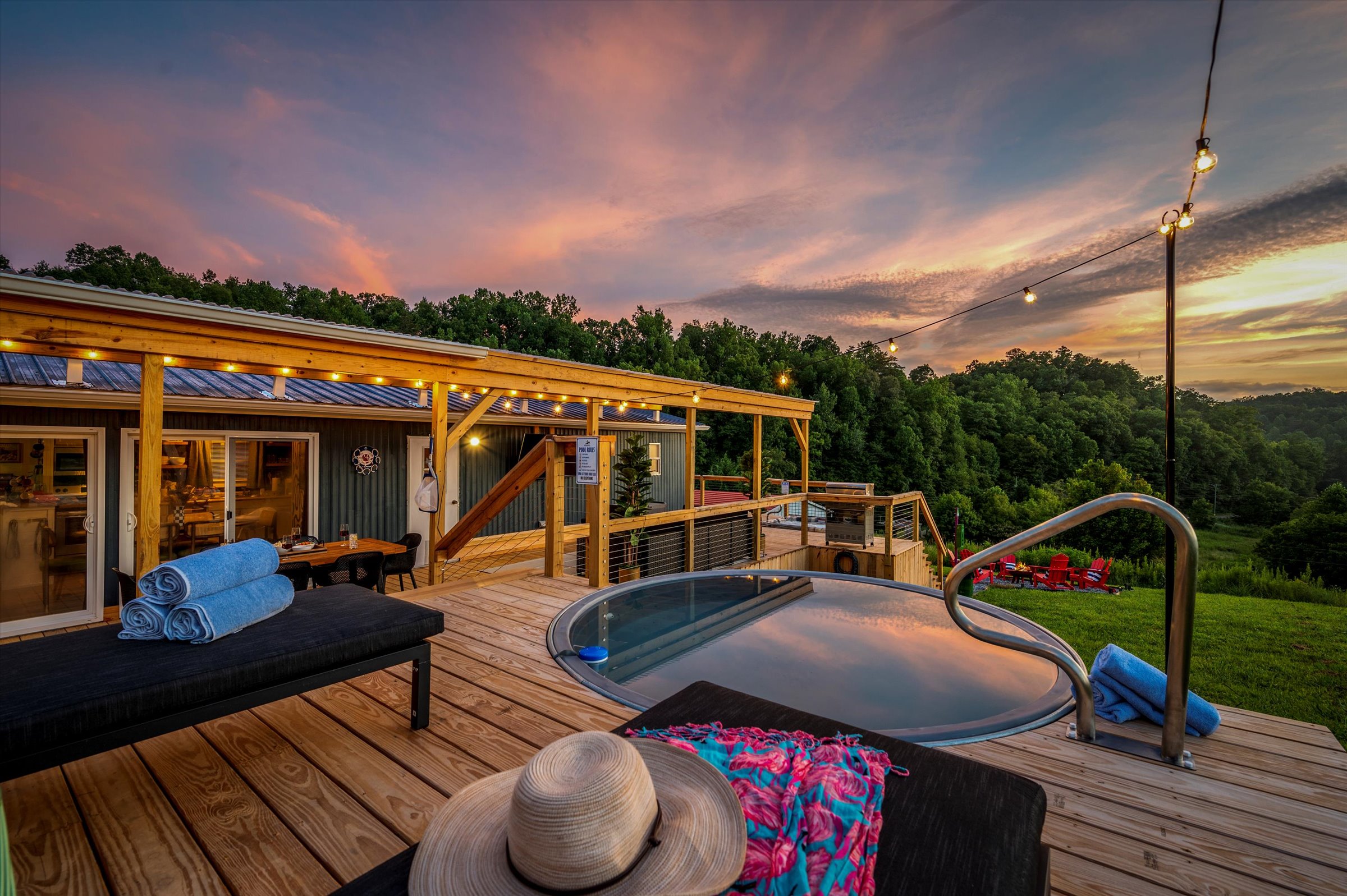
Kelly worked with us at Funkit because she wanted "colors that stop the scroll factor." She said yes to everything we showed her. The orange fridge. The cowboy pool. The game barn aesthetic.
She wasn't trying to blend in. She was trying to own a lane.
What happened two minutes after going live
14 bookings on day one.
The listing immediately started pulling $700/night during peak season. The average nightly rate settled around $230. Labor Day weekend hit $450. Holiday bookings were already coming in at $700.
Kelly had projected $66,000 in first-year revenue. She's on track to clear $73,000.
The numbers that matter
Monthly expenses:
- Mortgage: $1,800
- Cleaning: $1,250
- Utilities and outdoor maintenance: $1,000
Total: $4,050/month or $48,600/year
Year-one performance:
- Projected gross revenue: $73,000
- Annual expenses: $48,600
- Net profit: $24,400
- Cash invested: $179,500
- Cash-on-cash return: 13.6%
And this is the part that stopped us: out of the 30+ properties Kelly manages in the Smokies—cabins, lake houses, family rentals—the single-wide is performing better than all of them.
A trailer is outearning cabins in a market defined by cabins.
.jpg)
Why this worked when a cabin wouldn't have
A $355,000 cabin in the Smokies would've looked like every other cabin. Kelly would've been competing on the same metrics as thousands of other hosts: views, hot tub, proximity to Dollywood, review count.
The trailer gave her a different search lane. It photographed differently. It felt specific.
Guests scrolling through listings could picture the vibe in three seconds: quirky, fun, designed for groups who want to hang out and make it part of the trip.
The backyard became the hero shot. The game barn became a booking trigger. The orange fridge became the detail people remembered and mentioned in reviews.
She didn't just build a place to sleep between hikes. She built a reason to pick her listing over 47 other options in the same search.
The mistakes she avoided
Kelly didn't spend money on the stuff that sounds important but doesn't move bookings.
She didn't renovate the kitchen with granite counters. She didn't install luxury vinyl plank flooring. She didn't repaint everything in trendy neutrals.
Those upgrades matter for in-person experience and reviews. But they don't stop scrolling. They don't show up in the first three photos in a way that changes behavior.
Instead, she focused on creating visible, outdoor moments that guests could understand instantly:
A cowboy pool instead of a standard hot tub. A game barn instead of leaving the carport empty. Bold color instead of safe beige. A backyard that looked like an evening plan, not a fire ring with two chairs.
The design wasn't trying to appeal to everyone. It was trying to be the obvious choice for the right guest.
What happens next
Kelly's not done. The property is zoned for two structures, which means she's already planning the next phase.
Another trailer. Or maybe a tiny house. She hasn't decided yet. But the model is clear: add another unit, share the existing amenities, and double the revenue without doubling the infrastructure cost.
That's the play when you buy land instead of just a structure.
What this means if you're stuck at 60-70% occupancy
Most hosts assume the next move is buying another property. Kelly proved you can unlock more revenue by rethinking what you already have.
If your listing sits at 60-70% occupancy and looks like every other listing in your market, the problem isn't the property. It's that nothing in your photos gives guests a reason to choose you quickly.
You're asking them to compare you to ten other nearly identical options and pick based on price or reviews. That's a grind.
The listings that win give guests a reason to stop scrolling in three seconds. A backyard moment. A design detail. A space that makes groups say, "This is the one."
Kelly found hers with a cowboy pool and a game barn. Your version might be different. But the principle is the same: create something specific enough that the right guest recognizes it immediately.
Final thought
Kelly took a single-wide trailer in the most competitive short-term rental market in America and turned it into the top performer out of 30+ properties.
She didn't follow the cabin formula. She didn't play it safe. She bought land, built an experience, and let the design do the work.
The result: 13.6% cash-on-cash return in year one, with room to double down.
If you're sitting on a property that's performing fine but not great, the issue probably isn't the market. It's that your listing hasn't given guests a reason to care yet.
We can help you figure out what that reason is.
