

.jpg)
Families don't book like couples.
There's a group chat. There are opinions. And somewhere in that chat is a 7-year-old who just vetoed your entire trip because the house "looks boring."
When families scroll listings, they don’t care about square footage. They're asking themselves: will my kids be entertained, or will I spend the entire weekend hearing "I'm bored" while I'm trying to drink coffee in peace?
Design answers that question before you ever send a message.
Here's how we build spaces that make kids lose their minds and parents pull out their credit cards.
Kids don't care about your finishes
Adults notice crown molding and quartz countertops.
Kids see a purple bunk bed with a slide and that's it. Decision made. Trip booked.
We've watched this happen on dozens of projects. When a kid sees something they're excited about, the entire family dynamic shifts.
Parents stop price-shopping and start asking "is this available?"
That's the power of designing for the person who actually has veto power in the group chat.
.jpg)
Backyards that do the heavy lifting
Hotels have lobbies. Short-term rentals have backyards. That's the advantage, and we lean into it hard.
For one property, we built a traffic playground. Painted road lines, custom curated cars, enough space for kids to actually drive around without crashing into the fence every 10 seconds.
Is it extra? Yes. Does it photograph incredibly well and make parents think "my kids would go absolutely feral here"? Also yes.
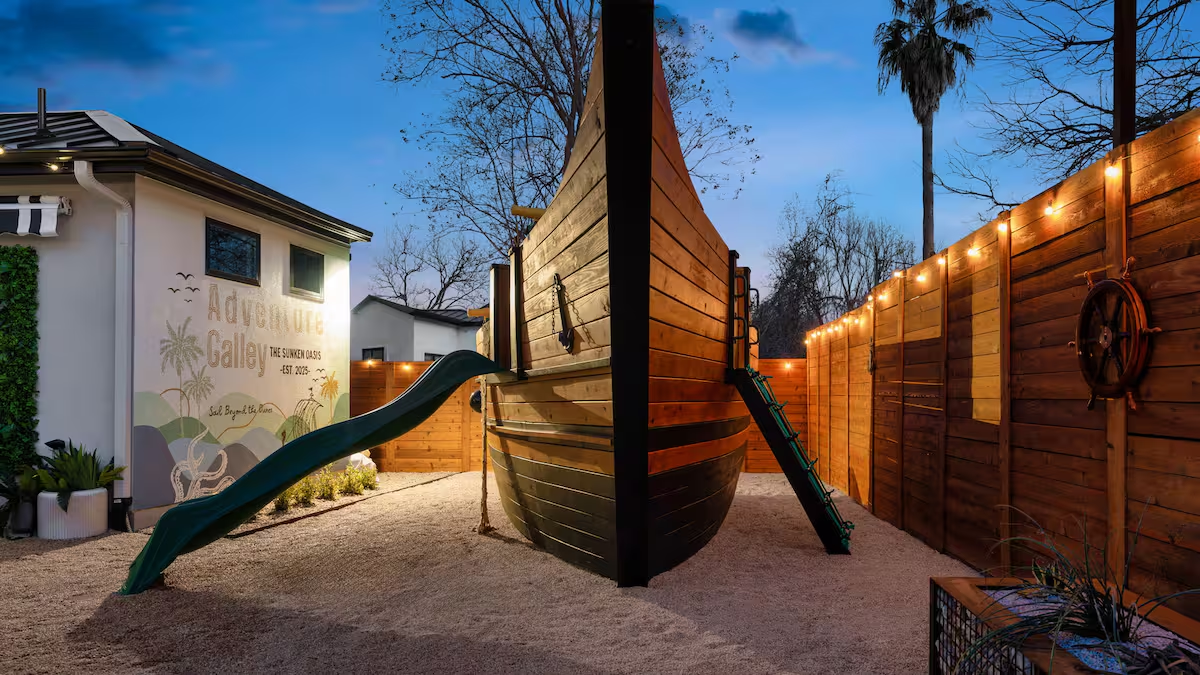
Another project: a custom pirate ship. Not a playset. A full pirate ship with a rock climbing wall on the side. The kind of thing where dads see it and immediately text the group "WE'RE BOOKING THIS ONE."
We don't call these amenities anymore. Amenities are hot tubs and WiFi.
This is the reason someone picks your house over 40 others.
.jpg)
.jpg)
Bunk rooms that don't look like a hospital ward
Most bunk rooms are tragic. Four identical beds, beige walls, zero personality.
The kind of room where kids ask if they can sleep in their parents' room instead.
We design them to be the room kids fight over.
Bright colors. Murals. Slides coming down from the top bunk. Climbing ropes. Confetti details on the ceiling. Spaces where bedtime actually sounds fun.
One project: yellow and purple bunk beds with a blue spiral slide. Striped wallpaper everywhere.
A climbing rope hanging in the corner. It looks like a birthday party waiting to happen.
Parents see it in the listing photos and know their kids will be talking about this trip for months. That's when the booking happens.
.jpg)
.jpg)
Why this works in family markets
In places where families are the main guests, blending in is expensive. You end up competing on price with 30 other "nice, clean" listings.
When your house has a slide or a pirate ship or a Power Wheels track, you're not competing anymore. You're the one getting sent to the group chat with "THIS ONE" underneath.
The design does the work before you ever respond to an inquiry.
What actually makes kid-friendly design work for Airbnbs
Commit to the bit. Don't do a "subtle" slide. Do a bright blue spiral slide that shows up in every photo.
Don't add a "play corner." Build a pirate ship.
Don't paint the bunk room beige and call it kid-friendly. Paint it purple and yellow and add confetti to the ceiling.
Families always book the thing their kid saw and immediately started begging for.
When the design is bold enough, the listing sells itself. No long descriptions needed. The photos do the talking.
Final thought
Kid-friendly design doesn’t mean you have to turn your property into a Chuck E. Cheese.
Design for the tiny human with veto power, and the rest takes care of itself.
When a 7-year-old gets excited, the trip is booked. When parents see a space where their kids will be entertained without constant supervision, they stop comparing prices and start asking about availability.
If your property targets families and you're tired of competing on price, let's talk.
