

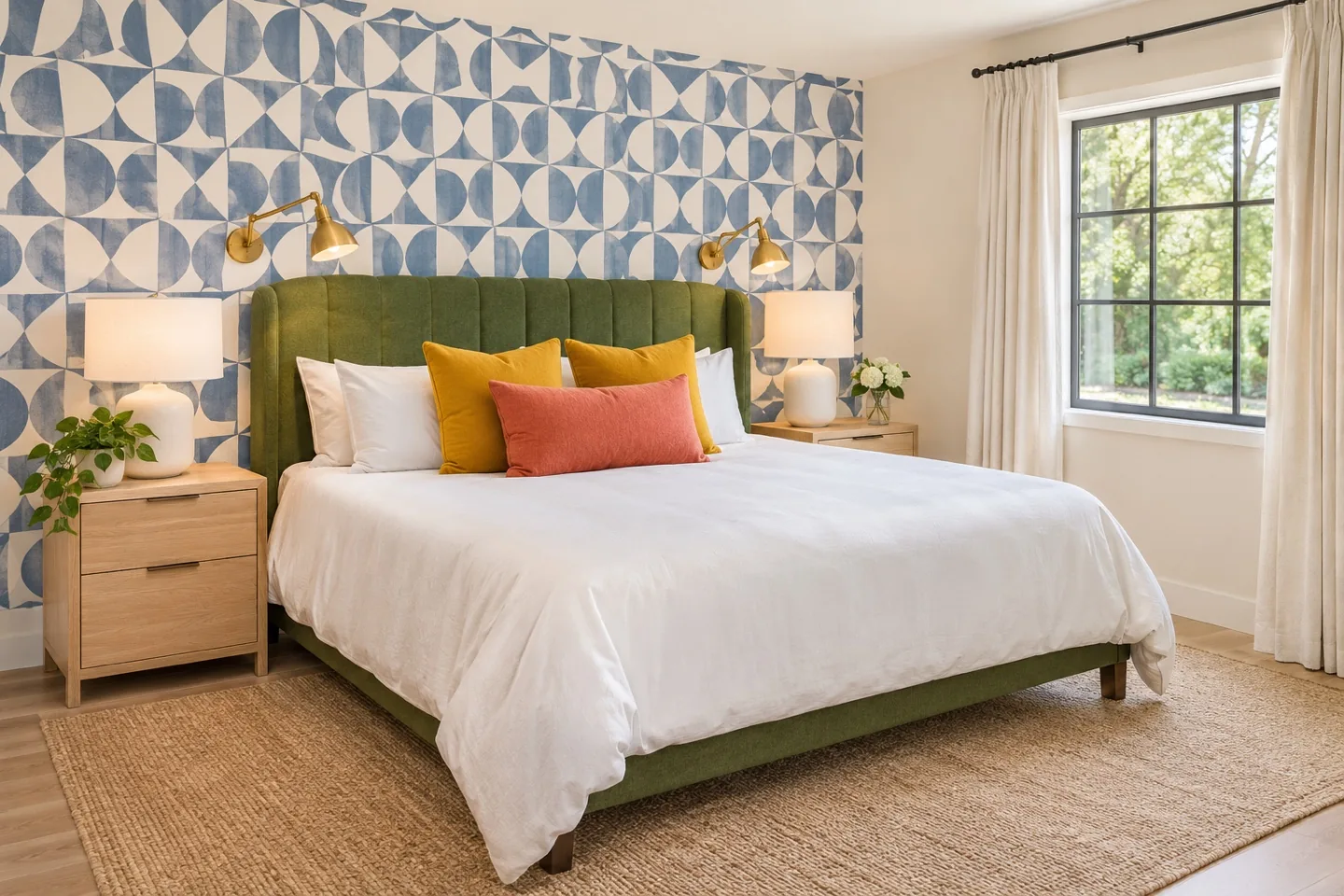
The expensive mistakes in a rental rarely look like mistakes. They look like a tasteful gray sofa, bright white can lights and a pretty kitchen nobody photographs, and they show up later as a cover photo guests scroll past.
Short answer: The Airbnb design mistakes that cost the most are decisions, not decor: designing for your own taste, copying the local look, spending outside the first 5 listing photos, buying finishes that can't survive turnovers and lighting rooms with cool bulbs. Most can be spotted in your own listing photos and fixed for less than a redesign.
Key takeaways:
- Guests rate every stay on Accuracy and Value, so a room that photographs better than it lives costs you twice.
- In our projects, the budget goes to the rooms in the first five listing photos; kitchens and bathrooms get cosmetic updates only.
- Warm bulbs at 2,700K to 3,000K read as home; 4,100K is what the US Department of Energy lists for offices and classrooms.
- Peel-and-stick wallpaper, white furniture in high-traffic rooms, carpet and battery lamps are on our ban list.
- Fix in order of cost: bulbs and clutter first, finishes at the next replacement, layout only with a plan.
What counts as an Airbnb design mistake?
An Airbnb design mistake is any choice that makes your listing less likely to be picked, harder to maintain or more likely to disappoint the guest who booked it. A white linen sofa is fine in your living room and a stain magnet in a house that turns over twice a week.
Airbnb design covers layout, sleep count, furniture, lighting, color and the moments guests photograph. Airbnb decor is the layer on top: art, pillows, accessories. The costly mistakes live in the first group, so swapping decor rarely fixes them. For planning a rental from scratch, see our guide to STR design.
Who should run this check, and who shouldn't?
Run it if your listing is live but its photos look like every comp at your price, if you're about to replace furniture anyway, or if reviews keep mentioning dark or cramped rooms.
Skip it if the property isn't furnished yet; start with layout and sleep count instead. Skip it too if your reviews are strong and your calendar moves with your market; a working design doesn't need fixing.
Why does a design mistake cost more in a rental?
Guests judge a rental twice: in the photos when they choose, and in the rating after they stay. Airbnb's Ratings for homes page (as of October 2026) asks them to rate Accuracy, "Was it accurately represented with up-to-date photos and info? Was everything in good working condition?", and Value, "Was it worth the price?"
A room that photographs better than it lives hits Accuracy; a flat one loses the click first.
Be fair to yourself about the market, though. AirDNA's 2026 Midyear Outlook found international short-term rental demand running 12% below last spring. If your calendar slowed, that's mostly the market; design decides your share of the guests still booking.
When should you fix a mistake, and when should you leave it?
Fix a mistake when it's cheap and visible, when the item is due for replacement anyway, or when it shows up in more than one review. Do it between seasons, then reshoot.
Leave it when the fix means construction in your peak weeks, when it never appears in a photo or a review, or when the money would earn more as an amenity your comps prove out.
The eight Airbnb design mistakes we see most
Each comes with the quickest way to spot it in your own listing.
1. Designing for your own taste. What feels calm and grown-up to you can look forgettable to a stranger. How to tell: you'd happily live there, and nothing in the first photo makes anyone stop. Even Rob, our co-founder, wanted "colorful Beetlejuice" for his Austin property; our team pushed a pink house built for bachelorette groups, and it became the Pink Pickle.
2. Matching the local look. Copying your neighbors makes you one more thumbnail. How to tell: put your cover photo beside your top five comps; can you find yours in two seconds? We contrast the local norm: modern in rustic cabin markets, color in all-white beach markets.
3. Spending on rooms guests don't see first. A kitchen remodel rarely moves bookings the way a living room does. How to tell: check whether your last big purchases sit in your first five photos. We put the budget into the living room, game room and primary suite.
4. Fragile finishes. Peel-and-stick wallpaper lifts, white upholstery stains, carpet holds every spill. How to tell: anything you've replaced twice in a year. We use washable rugs, dark performance fabrics and paint or glued wallpaper instead.
5. Bad lighting. One overhead fixture and cool bulbs flatten a room in person and on camera. It gets its own section below.
6. More beds instead of better beds. An extra twin adds a guest on paper and a complaint in practice. How to tell: count bathrooms. We plan about five guests per bathroom, kings wherever they fit, queen-over-queen bunks and no twins.
7. Clutter. Too many pillows and knickknacks make a room look smaller in photos. Airbnb's photo guidance (2024) tells hosts to "clean and declutter" before shooting. In small bedrooms we cut decorative pillows, because guests have nowhere to put them.
8. No hero shot. Every key room needs one moment worth stopping on, like a statement wall or a bunk room. If you can't name your living room's hero shot, it doesn't have one.
Why does bad lighting make your Airbnb photograph badly?
Cool bulbs and a single overhead fixture produce flat, blue, shadow-heavy rooms. Good Airbnb lighting design uses one warm bulb color and several light sources at different heights.
The US Department of Energy's lighting guidance (2023) lists warm 2,700K and soft 3,000K bulbs for homes and restaurants, and cool 4,100K for offices and classrooms. It also warns that a radical change in color temperature, such as 2,700K to 4,100K, "is noticeable and can result in occupant dissatisfaction."
Mixed bulbs are the classic version: a warm lamp beside a daylight ceiling bulb leaves half the photo orange and half blue. Pick one warm temperature for the whole house and buy it in bulk.
We add lamps and sconces to supplement harsh can lights, and we rank lighting among the highest-return lines in a design. On one project the owner skipped a custom mantle and spent the money wiring sconces and lamps instead. Our Airbnb photos guide covers the shoot itself.
How Funkit spots what a design is getting wrong
Every project we run starts from data, not taste: a 3D scan of the property and a report on the top comps near it. To check your own listing, run the same logic in this order:
- Comps: compare cover photos, sleep counts and amenities with the top listings near you.
- First five photos: does each have a hero moment, and is your budget in those rooms?
- Reviews: separate design complaints (dark, cramped, worn) from cleaning and check-in issues.
- Durability and lighting: anything on the ban list, any battery lamp, any room lit by one fixture.
What we see in Funkit projects: A first draft often gets called "like a personal home," and the fix is usually easy swaps like rugs, wallpaper and warm lamps, not new furniture. In tight layouts we force a king into one awkward "sacrificial" room and keep it out of the hero photos. When a budget is tight, we cap lamps around $60 in durable wood or rattan rather than cut the lighting plan.
Which mistake should you fix first?
Fix the cheap, visible mistakes first and the structural ones last:
- This week: one warm bulb temperature everywhere, plug-in lamps instead of battery ones, clutter and extra pillows gone.
- This month: a lamp or sconce in every room lit by one ceiling fixture, and one hero moment in the living room.
- At the next replacement: durable versions of white upholstery, carpet and peel-and-stick.
- With a plan: layout, sleep count and conversions. In our experience a 6th or 7th bedroom often adds only $5,000 to $10,000 a year, so model it before you build it.
Steps 1 and 2 are easy to do yourself. Step 4 is where a wrong guess gets expensive: Rob once delayed his own property by nearly a year, a story we tell in the hidden cost of designing your Airbnb yourself.
Frequently Asked Questions
Can you fix Airbnb design mistakes without taking the listing offline?
Yes, most of them. Bulbs, lamps, rugs and pillows can be swapped between two turnovers without blocking a night. Plan paint, wallpaper and furniture deliveries for a slow week, then reshoot the changed rooms so your photos match what guests find and your Accuracy rating stays protected.
Should you use your own furniture in an Airbnb?
You can, if it's durable and fits the plan. Beds, frames and TVs in good shape are often worth keeping, and reuse is one of the easiest ways to save. Leave out anything fragile, sentimental or chosen purely for your taste, because guests will treat it like hotel furniture.
How many lamps does an Airbnb room need?
More than one, and never just the ceiling fixture. Give every bed a lamp on each side, because guests use them nightly, and mix table, floor and wall lights in living areas so light comes from different heights. Use plug-in lamps and keep every bulb the same warm temperature.
